A magical touch to AI Readiness

AI is getting dramatically better. But many enterprises still struggle to make their data truly AI-ready. Why?
The demo works.
The pilot is impressive.
Then the AI meets the enterprise.
It encounters three definitions of “active customer,” a critical table nobody clearly owns, a pipeline whose failure is discovered only when a dashboard goes blank, and business rules that live in the memory of the engineer who built the system five years ago.
Suddenly, the intelligence looks less intelligent.
This is the black magic of AI readiness: the invisible knowledge, assumptions, dependencies, and human interventions that make enterprise data appear reliable. Well, until a machine is asked to use it at scale.
The problem is rarely that an organization lacks data. The problem is that the data arrives without enough context to be trusted, interpreted, and acted upon safely.
More data does not mean more readiness
The world created roughly 120 zettabytes of data in 2023 and was projected to create about 181 zettabytes in 2025, an increase of approximately 51% in two years, not a shortage by any measure.
Yet ask a few simple questions inside almost any large organization:
- What does this metric mean?
- Who owns this dataset?
- Where did this number come from?
- How fresh is it?
- What will break if this schema changes?
- Is the business rule documented anywhere other than in someone's head?
The answers are often incomplete, inconsistent, or slow to find.
That is the paradox of enterprise AI. Models can summarize, generate, classify, recommend, and increasingly act. But a model cannot reliably compensate for missing institutional context. Give it conflicting definitions and it will choose one. Give it stale data and it will reason from the past. Hide a dependency and it will act as though the dependency does not exist.
AI does not remove ambiguity. It accelerates whatever the organization gives it, including the ambiguity 🙂
The most dangerous state is an automated execution with undocumented knowledge
There are two questions every enterprise should ask before scaling AI:
- Where does our knowledge live - in people or in systems?
- How is work executed - by people or by AI agents?
Those questions reveal four operating states:
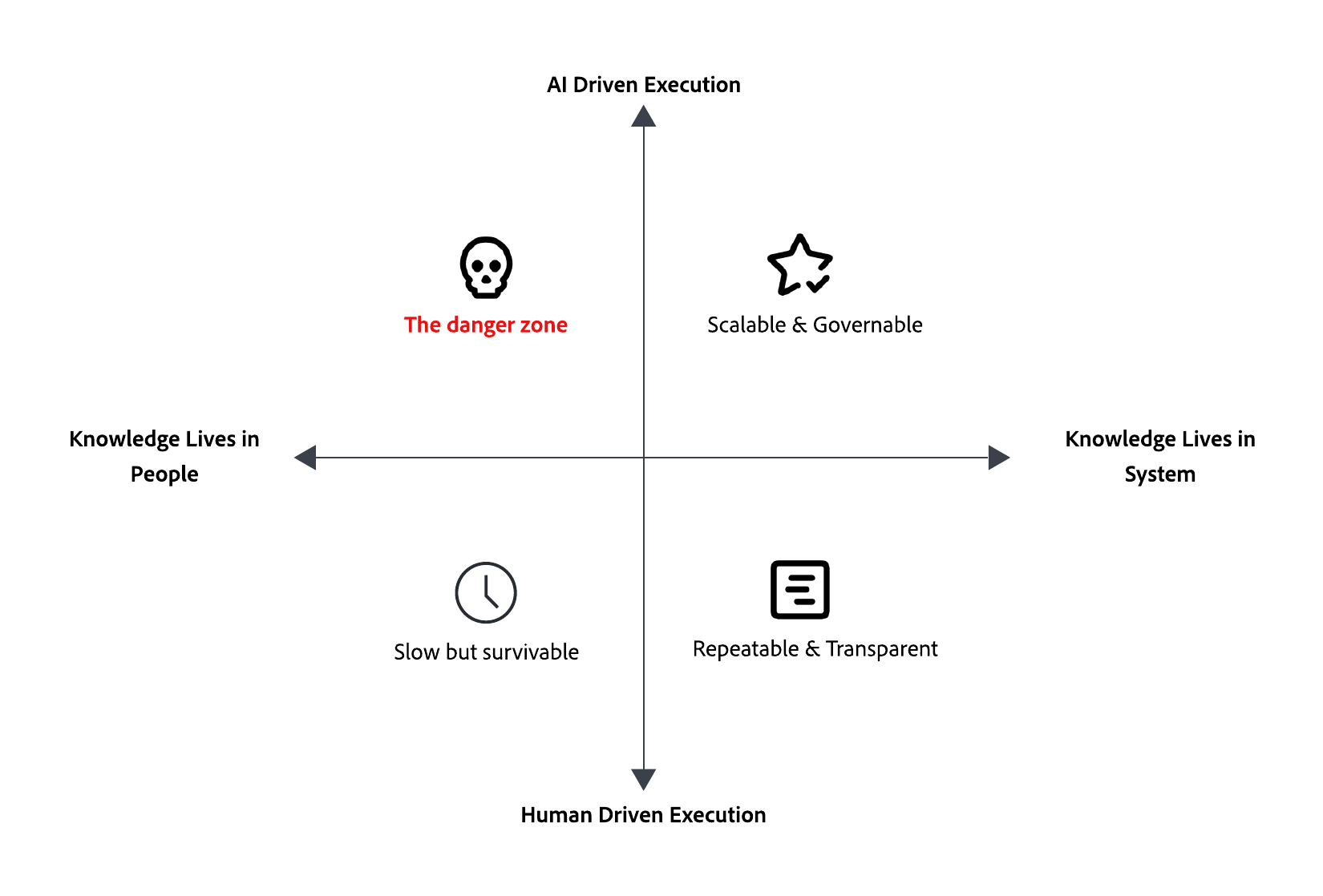
Many organizations are trying to jump directly from the bottom-left of their operating model to the top-right: from 'tribal knowledge and manual coordination' to agentic automation.
Instead, they land in the danger zone!
Agents are asked to generate code, answer business questions, classify data, or make recommendations without access to canonical definitions, end-to-end lineage, ownership, quality expectations, or the history behind previous decisions. The output may look polished and technically plausible while being disconnected from business reality.
The organization gets faster execution but also faster propagation of errors.
That is why the intelligence layer cannot safely outrun the knowledge layer.
AI readiness is a supply-chain problem
Enterprises often treat data as an IT asset: something to collect, store, secure, and occasionally clean.
But data does not sit still. It moves.
It is produced by one system, transformed by another team, enriched with business logic, checked or not checked for quality, and consumed by someone who may have no visibility into what happened along the way. Increasingly, it is also consumed by a model or an agent expected to take action.
That is not a static asset. It is a supply chain.
Physical supply chains have specifications, contracts, quality gates, named owners, traceability, and escalation paths. Most enterprise data supply chains grew differently: one integration/dashboard/request at a time.
The result is a chain of fragile handoffs:
- Marketing and Engineering use different definitions for the same metric.
- An upstream team changes a schema without knowing which models depend on it.
- A pipeline meets its technical SLA but delivers data too late for the business decision.
- A dashboard shows a number without exposing its source or transformation history.
- A model consumes a feature that has silently drifted from its original meaning.
No single team necessarily did anything wrong. The chain itself was never deliberately engineered.
Breaking the spell
There is no magical tool that makes an enterprise AI-ready. Warehouses, lakehouses, catalogs, governance platforms, and models all matter, but none can substitute for engineering the handoffs between them.
Five disciplines make the difference:
1. Put knowledge into the system
Business definitions, quality expectations, ownership, policies, and operational history cannot remain tribal knowledge. They must be discoverable and machine-readable so that people and agents reason from the same institutional context.
2. Replace assumptions with contracts
Every important handoff should define what is being delivered: schema, meaning, freshness, quality thresholds, and change expectations. A consumer should not have to reverse-engineer what a producer intended.
3. Test quality before the handoff
A physical supply chain does not wait for the customer to discover a faulty part. Data quality should work the same way. Failures should be detected where they originate, not three transformations later when an executive questions a dashboard.
4. Make every dependency traceable
When a number looks wrong or a schema is about to change, the organization should be able to trace the path from source to decision and identify the blast radius before acting. Lineage is not documentation decoration; it is operational intelligence.
5. Keep humans accountable while machines accelerate
AI can classify, draft, test, monitor, route, and recommend. Accountability still belongs to people. The goal is not to remove human judgment but to stop wasting it on finding definitions, reconstructing dependencies, and chasing owners.
The real black magic
The black magic was never inside the model.
It was the undocumented business rule. The silent schema change. The spreadsheet reconciliation. The engineer who knew which job to restart. The analyst who remembered why two revenue figures never matched. The meeting that existed only to discover who was blocking whom.
For years, people absorbed these gaps and kept the system moving. AI exposes them because machines cannot reliably operate on context that the enterprise has never made explicit.
The organizations pulling ahead will not simply have better models. They will have data supply chains in which meaning is shared, ownership is visible, quality is enforced, dependencies are traceable, and decisions can be explained.
That is the real foundation of AI readiness: not magic, but disciplined engineering of everything the magic used to hide.
Sources
- An upcoming book
- Gartner, How to Improve Your Data Quality (2021), citing an average annual cost of poor data quality of $12.9 million